Substrates
I mentioned substrates, ephemerides, and artifacts in the chapter on system architecture. Here I’ll present an example.
First I’d like to draw attention to a certain property of the algebraic expressions introduced. In practice we can write any expression, compile it, and produce a formula for operations on individual elements of the time series that yields the desired result.
In practice, the system carries out only one- or two-argument operations. Examples of one-argument operations are the time shift or the Agse operation — there, the argument is a single data stream. The rest of the operations act on two data streams. During compilation, all algebraic expressions are broken down into ones with two arguments.
The parser accepts both the parenthesized form and unparenthesized chains, e.g. s1+s2+s3, s1#s2#s3, and s1+s2+s3+s4. Such notation is then reduced to a sequence of two-argument operations with automatic intermediate substrates.
The example uses the canonical declarations from the whole chapter — three streams with different types and intervals:
DECLARE a BYTE, b INTEGER \
STREAM core0, 0.1 \
FILE 'sensor_a.txt'

DECLARE c INTEGER, d FLOAT \
STREAM core1, 0.2 \
FILE 'sensor_b.txt'

DECLARE e INTEGER \
STREAM core2, 0.3 \
FILE 'sensor_c.txt'

SELECT merged[0] \
STREAM merged \
FROM (core0 # core1) + core2
Compilation:
$ xretractor -c query.rql
STREAM_HASH_core0_core1(1/15)
        :- PUSH_STREAM(core0)
        :- PUSH_STREAM(core1)
        :- STREAM_HASH
        a: BYTE
                PUSH_ID(STREAM_HASH_core0_core1[0])
        b: INTEGER
                PUSH_ID(STREAM_HASH_core0_core1[1])
        c: INTEGER
                PUSH_ID(STREAM_HASH_core0_core1[2])
        d: FLOAT
                PUSH_ID(STREAM_HASH_core0_core1[3])
merged(1/15)
        :- PUSH_STREAM(STREAM_HASH_core0_core1)
        :- PUSH_STREAM(core2)
        :- STREAM_ADD
        merged_0: BYTE
                PUSH_ID(merged[0])
core0(1/10)     sensor_a.txt
        a: BYTE
        b: INTEGER
core1(1/5)      sensor_b.txt
        c: INTEGER
        d: FLOAT
core2(3/10)     sensor_c.txt
        e: INTEGER
An unannounced stream, STREAM_HASH_core0_core1, appeared — this is exactly a substrate. The compiler broke (core0 # core1) + core2 into two two-argument operations and inserted an intermediate stream. The substrate’s delta: Δ = (1/10 · 1/5) / (1/10 + 1/5) = 1/15.
What happens once we attach the query:
SELECT merged2[0] STREAM merged2 FROM (core0 # core1) > 2
Only one new query gets attached to the plan:
merged2(1/15)
        :- PUSH_STREAM(STREAM_HASH_core0_core1)
        :- STREAM_TIMEMOVE(2)
        merged2_0: BYTE
                PUSH_ID(merged2[0])
You’re probably wondering why only one, and not two again? The answer is optimization. We’re reusing the intermediate results from before. This is one of the unexpected benefits of using RetractorDB.
There’s one more important thing worth mentioning here. There is a SUBSTRAT directive, whose argument is a string in quotes. You can use the following types: ‘memory’, ‘default’, ‘direct’, ‘posix’, ‘posixshd’, ‘generic’, ‘device’, ‘textsource’. A full description of each type can be found in the chapter Storage Types. The default type, ‘default’, causes substrates to materialize entirely on disk. That’s not the desired behavior in a production system, but it is desired during development and debugging. A useful type is ‘memory’. Substrates of this type live only in memory. Their data never lands on disk — everything happens in memory, and there’s only as much data as is needed to execute the queries. The remaining types are currently untested and in development.
Adding a query with the same operations but a different name can trigger substrate deduplication. If the program, delta, and schema are equivalent, the compiler redirects the PUSH_STREAM references to the existing stream and removes the duplicate.
NOTE: The functionality described here is covered by the tests:
issue96_no_substrat_reduction,issue96_substrat_reference, described in the appendix Integration Tests.
Substrate reduction
The compiler carries out an optimization called substrate reduction (the deduplicateSubstrats function). It works as follows: if the user has defined a query structurally identical to a generated substrate, the substrate is removed from the plan and its references are replaced with the user query’s name.
Conditions for reduction
Reduction of a substrate into a user query happens if and only if three conditions are simultaneously satisfied:
- The same schema shape — the field count, types, byte sizes, and cardinalities are identical. Field names are not compared.
- The same delta — the streams’ sampling rate is the same.
- The same processing operations — the sequence of
PUSH_STREAM/STREAM_TIMEMOVE/STREAM_HASH, etc. instructions is identical.
Reduction example
Consider a query with the canonical declarations:
DECLARE a BYTE, b INTEGER   STREAM core0, 0.1 FILE 'sensor_a.txt'
DECLARE c INTEGER, d FLOAT  STREAM core1, 0.2 FILE 'sensor_b.txt'

SELECT merged[0] STREAM merged FROM (core0 > 2) + core1
SELECT shifted[0] STREAM shifted FROM core0 > 2
Without reduction, the compiler would generate three streams: the substrate STREAM_TIMEMOVE_core0, merged, and shifted. The substrate and shifted have an identical structure — the same source stream core0 and the same >2 operation. After reduction, the substrate is removed, and the reference PUSH_STREAM(STREAM_TIMEMOVE_core0) inside merged is replaced with PUSH_STREAM(shifted):
merged(1/10)
        :- PUSH_STREAM(shifted)
        :- PUSH_STREAM(core1)
        :- STREAM_ADD
        merged_0: BYTE
                PUSH_ID(merged[0])
shifted(1/10)
        :- PUSH_STREAM(core0)
        :- STREAM_TIMEMOVE(2)
        shifted_0: BYTE
                PUSH_ID(shifted[0])
core0(1/10)     sensor_a.txt
        a: BYTE
        b: INTEGER
core1(1/5)      sensor_b.txt
        c: INTEGER
        d: FLOAT
An important restriction: only substrates are reduced
Reduction applies exclusively to substrates generated by the compiler (isSubstrat = true). Queries explicitly defined by the user are never reduced, even if two of them have an identical structure.
Example — two user queries with the same operation:
DECLARE a BYTE, b INTEGER   STREAM core0, 0.1 FILE 'sensor_a.txt'

SELECT shifted1[0] STREAM shifted1 FROM core0 > 2
SELECT shifted2[0] STREAM shifted2 FROM core0 > 2
The compilation result keeps both streams, with no reduction at all:
shifted1(1/10)
        :- PUSH_STREAM(core0)
        :- STREAM_TIMEMOVE(2)
        shifted1_0: BYTE
                PUSH_ID(shifted1[0])
shifted2(1/10)
        :- PUSH_STREAM(core0)
        :- STREAM_TIMEMOVE(2)
        shifted2_0: BYTE
                PUSH_ID(shifted2[0])
core0(1/10)     sensor_a.txt
        a: BYTE
        b: INTEGER
This semantic decision is deliberate: the user declared two separate output streams, and both are entitled to exist independently in the execution plan. The deduplicateSubstrats() pass removes neither of them. The compiler may, however, share their internal computation while retaining both public streams, as described in the next section.
Sharing equivalent SELECT computations
The shareEquivalentSelectComputations() pass detects explicit SELECT queries that execute the same field program over equivalent FROM trees containing STREAM_ADD. Instead of executing the expensive program separately for each query, the compiler creates one STREAM_SELECT_* substrate. The public streams remain in the plan as lightweight projections of that substrate.
Example:
SELECT a[_] * b[_] STREAM c1 FROM a+b
SELECT a[_] * b[_] STREAM c2 FROM b+a
After field references are resolved, both field programs read the same values from a and b, even though the stream + operator builds its input in a different order. The plan contains one shared computation, for example STREAM_SELECT_c1, and two public streams, c1 and c2, that read its fields.
Equivalence conditions
Two queries may share a computation only when:
- they have the same result interval;
- they have the same number and order of result fields;
- corresponding fields have the same type, size, and cardinality;
- after field references and
[_]are expanded, the field programs read the same source fields and execute the same operations in the same order; - the
FROMtrees are equivalent while preserving their grouping.
The tree fingerprint canonically orders the two children of each individual STREAM_ADD node, so a+b may be equivalent to b+a. It does not flatten the tree or assume associativity. This matters for three sources with different intervals:
SELECT p[_] * q[_] + r[_] STREAM x1 FROM (p+q)+r
SELECT p[_] * q[_] + r[_] STREAM x2 FROM (q+p)+r
SELECT p[_] * q[_] + r[_] STREAM x3 FROM (r+q)+p
Queries x1 and x2 may share their computation because they swap only the children of the same inner node. Query x3 has different grouping and a different intermediate substrate; its execution cadence may differ, so it remains independent.
Input order is also observable through a full scan and through projection order. The following pairs must not be merged:
SELECT * STREAM d1 FROM a+b
SELECT * STREAM d2 FROM b+a

SELECT a[0], b[1] STREAM n1 FROM a+b
SELECT b[1], a[0] STREAM n2 FROM b+a
Preserving the public contract
The optimization shares only the internal computation. Every explicit stream retains its own name, schema and descriptor, rules, retention, storage policy, and artifacts. Automatically generated field names may therefore still differ between c1 and c2, even when their data is identical. This is not a full alias: no public stream disappears from the plan, IPC, or storage.
After creating the common STREAM_SELECT_*, the compiler removes orphaned substrates to a fixed point. During ad hoc import, analysis is restricted to new identifiers so recompilation cannot rewrite streams that have already been instantiated in the live plan.
The pass runs after resolveFieldReferences() and expandIndexWildcards(), but before localizeFieldOffsets(). This lets a field fingerprint compare the source identity and index instead of a local offset that depends on whether the input order is a+b or b+a.
The select_cse_commutative_add test checks both plan shape and execution. It covers equivalent indexed projections and explicit field lists, NULL values and their metadata, separate public descriptors, SELECT *, changed field order, and positive and negative three-source cases. The test compares equivalent pairs byte for byte and confirms that the counterexamples produce different results — see Integration Tests.
Elimination of duplicate substrates
When several queries use the same stream operation — e.g. core0 + core1 — the substrate-extraction phase (extractIntermediateStreams) creates a separate substrate for each of them. Without a subsequent repair phase, the graph would end up with parallel, identical intermediate nodes computing exactly the same value.
When a substrate is created
A substrate is generated for every query whose program contains more than one stream operator. This applies to the operators: STREAM_ADD, STREAM_SUBTRACT, STREAM_HASH, STREAM_DEHASH_DIV, STREAM_DEHASH_MOD, STREAM_TIMEMOVE, STREAM_AGSE. The condition is checked by the query::isReductionRequired() function.
The newly created substrate is given a name built from the operation symbol and the operand names, e.g. STREAM_ADD_core1_core0 (the composeStreamName function in compiler.cpp). In the parent query’s program, the operator token is replaced with a PUSH_STREAM token pointing at this substrate.
Matched interleave-shift factorization
After extracting substrates and resolving their intervals, the compiler applies the algebraic rewrite:
\[ (A > i) \mathbin{\#} (B > k) \longrightarrow (A \mathbin{\#} B) > (i+k), \qquad i\Delta_{a}=k\Delta_{b} \]
The condition \(i\Delta_{a}=k\Delta_{b}\) means that both interleave arguments are shifted by the same physical time. Without this condition the transformation is not equivalent, so the compiler keeps the original plan.
Let the reduced ratio \(\Delta_a/\Delta_b\) be \(p/q\). The interleave tail protects every phase of the period \(p+q\), because the compiler scans that period slot by slot and takes the maximum required latency — formula and justification in Formal Foundations and Proofs.
A shift delays a causal realization: it moves the logical origin O by N
and sets its own tail to \(\max(0,W_S-N)\) — it does not change the record
sequence or insert a prefix. For
\(\Delta_c=\Delta_a\Delta_b/(\Delta_a+\Delta_b)\), the matching condition
gives exactly:
\[ \frac{i\Delta_a}{\Delta_c} =\frac{k\Delta_b}{\Delta_c} =i+k \]
Shifting each input therefore corresponds to the same number i+k of output
slots, and the logical origin of both sides is identical. The tails are not
identical. The factored side reads content directly from the interleave, while
the unfactored side reads it only after shifting its components, so it waits
longer:
\[ W_{\mathrm{RHS}}=\max\left(0,;W_{\varphi(A,B)}-(i+k)\right)\le W_{\mathrm{LHS}} \]
The rule thus preserves the emitted sequence, the interval and origin=, and may
decrease tail=. It is a latency optimization, not a neutral rewrite; for
the full proof and a counterexample see Formal foundations and
proofs.
Before optimization the plan contains two substrates:
STREAM_TIMEMOVE_A = A > i
STREAM_TIMEMOVE_B = B > k
result = STREAM_TIMEMOVE_A # STREAM_TIMEMOVE_B
After optimization only one remains:
STREAM_HASH_A_B = A # B
result = STREAM_HASH_A_B > (i + k)
The factorMatchedHashTimeMoves() pass does not remove explicit user streams or substrates used by other consumers. It runs before deduplication so that the exposed A # B substrate can subsequently be shared with another equivalent plan.
The issue202_hash_shift_e2e test executes both sides of the identity over
independent copies of file-backed input streams. It compares the matched
and CC artifacts byte for byte, compares their metadata after excluding
the creation timestamp, checks the complete sequence against a reference
derived from the B,A,A interleave period, and verifies equal tails
(origin=3 with a zero tail — \(\tau_3\) over an interleave of tail 2
absorbs it entirely). Both sides are factored to the same shape here, so the
comparison is exhaustive. Neither side emits placeholder records. Separately,
computeRequiredCapacities() assigns N+1+2 history records to a declared
source: N+1 for the read range itself and two for the declaration’s head
lead, which logical-index addressing does not shorten.
The r1_identity_nulls test checks the same identity for
\(\Delta_a/\Delta_b=3/2\), which requires the phase maximum
\(H_{a,b}=2\) even though the first phase requires only one slot. It
compares the rewritten plan, a left-hand side blocked from rewriting, and
an explicit right-hand side. The rewritten plan and the explicit right-hand side
are equal in full. The blocked left-hand side has the same logical origin and
the same content but a strictly larger tail — the comparison therefore covers the
common prefix of the payload and of the NULL map, with a separate assertion
requiring the factored side to be strictly longer. A nonempty periodic
all-NULL record prevents missing data from masking an incorrect tail. Compiler unit tests
also cover the \(3/5\), \(7/11\), and \(160/147\) ratios.
The deduplication algorithm
After extracting substrates and determining time intervals, the compiler runs the deduplicateSubstrats() step. The algorithm works iteratively — a while(changed) loop repeats the search until no more duplicate pairs are found.
On every pass, for each pair of substrates (it, it2), five equivalence conditions are checked in turn:
- Time interval –
it->rInterval == it2->rInterval - Program length – the number of tokens in
lProgrammust be identical - Schema length – the number of fields in
lSchemamust be identical - Program content – every token is compared by instruction type (
getCommandID()) and parameter value (getVT()) - Schema content – every field is compared by type (
rtype), size in bytes (rlen), and cardinality (rarray)
If all conditions hold, substrate it is considered a duplicate of substrate it2. The compiler walks through the entire coreInstance and, in every PUSH_STREAM token referring to the old name (it->id), substitutes the new name (it2->id). The duplicate is then removed from the query list (coreInstance.erase(it)), and the loop starts over.
Position in the compilation pipeline
Deduplication is the fifth step of the pipeline (the compiler::compile() function):
1. extractIntermediateStreams   – substrate extraction
2. expandSchemaWildcards        – expansion of wildcard symbols in schemas
3. resolveStreamIntervals       – time-interval computation
4. factorMatchedHashTimeMoves   – matched interleave-shift factorization
5. deduplicateSubstrats         – duplicate elimination  ← this step
6. resolveFieldReferences       – field-reference resolution
7. expandIndexWildcards         – expansion of wildcard indices
8. shareEquivalentSelectComputations – sharing equivalent SELECT computations
9. localizeFieldOffsets         – field-offset computation
10. computeStartupLatency       – startup-tail computation
11. computeRequiredCapacities   – required-history computation
12. validateConstraints         – operator-constraint validation
13. applyCapacitiesToStreams    – capacity application
14. topologicalSort             – final producer–consumer order
Matched interleave-shift factorization and deduplication must happen after step 3 because both operations compare intervals. Deduplication follows the algebraic rewrite so that it can merge interleave substrates exposed by that rewrite.
SELECT computation sharing runs only after field references and [_] have been expanded because it compares completed field programs. It must still precede field-offset localization so equivalent sources do not look different merely because of their order in the local input buffer.
Every rewriting pass (factorMatchedHashTimeMoves,
deduplicateSubstrats, and shareEquivalentSelectComputations) is wrapped
in verifyUserFieldNamesPreserved(). Field names of public streams are part
of the .desc descriptor and must not change because of optimization. The
tail is computed only for the final plan. The final topological sort is
unconditional because earlier interval sorting can place a faster #
consumer before its producers.
Effect on the dependency graph
Consider the queries:
DECLARE a UINT STREAM core0, 0.1 FILE 'datafile1.txt'
DECLARE a UINT STREAM core1, 0.1 FILE 'datafile2.txt'
SELECT str4[0] STREAM str4 FROM (core0+core1)>2
SELECT str5[0] STREAM str5 FROM (core0+core1)>3
Both queries require the sum core0+core1 to be computed first.
The extractIntermediateStreams phase creates a separate substrate for each query, producing two identical intermediate nodes in the graph (Fig. 36):
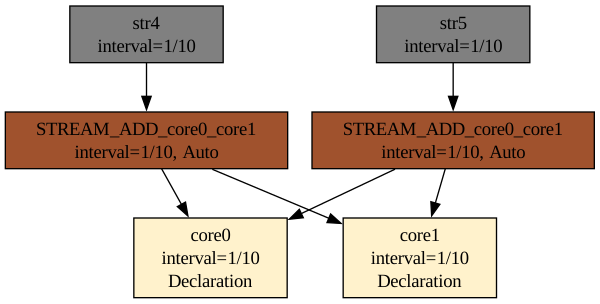
Fig. 36. Graph before deduplication — two identical STREAM_ADD_core0_core1 substrates
Once deduplicateSubstrats() runs, one of the duplicates is removed and every PUSH_STREAM reference is repointed to the surviving node. A single shared substrate remains in the graph (Fig. 37):
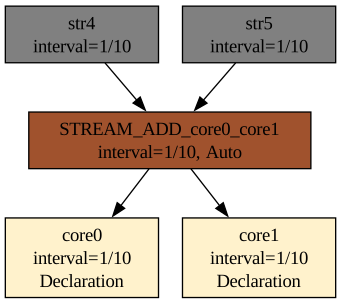
Fig. 37. Graph after deduplication — one shared substrate, generated with: xretractor dedup_after.rql -c -d
The graph after deduplication is exactly what xretractor -c -d returns — the compiler always presents the result after all optimization phases.
Absorption of a substrate by an explicit stream
The inner loop in deduplicateSubstrats() does not check the isSubstrat flag for candidate it2 — that check exists only in the outer loop. This means an automatic substrate can be absorbed not only by another substrate, but by any stream with an identical program and schema — including a stream explicitly defined by the user.
Consider a query containing only a compound expression:
DECLARE a UINT STREAM core0, 0.1 FILE 'datafile1.txt'
DECLARE a UINT STREAM core1, 0.1 FILE 'datafile2.txt'
SELECT str4[0] STREAM str4 FROM (core0+core1)>2
Here, extractIntermediateStreams extracts a substrate STREAM_ADD_core0_core1 for the expression core0+core1. Artifact str4 depends on it (Fig. 38):
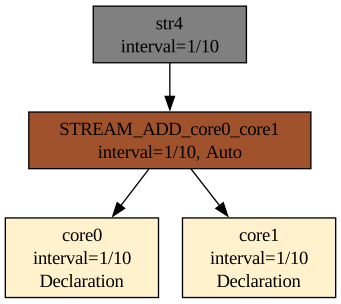
Fig. 38. Graph with the automatic substrate STREAM_ADD_core0_core1
When the user adds an explicit stream declaration that is exactly the same sum:
SELECT * STREAM mysum FROM core0+core1
the substrate STREAM_ADD_core0_core1 satisfies every equivalence condition relative to mysum — identical interval, identical token program, identical field schema. The deduplicateSubstrats() phase removes the substrate and repoints every PUSH_STREAM reference to mysum. The substrate disappears from the graph entirely (Fig. 39):
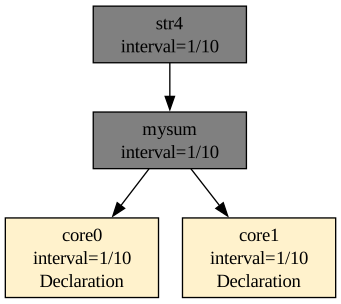
Fig. 39. Graph after adding SELECT * STREAM mysum FROM core0+core1 — the substrate replaced by an explicit stream
A side effect: mysum becomes a shared node — it serves both its own consumers and those that previously used the automatic substrate. In exchange, the user gains an explicit name for the intermediate results and can query them via xqry.
Schema update after absorption
Simply repointing the PUSH_STREAM tokens is not enough. Every stream stores, in lSchema, a sequence of instructions describing how to build the output value of every field — including PUSH_ID(stream_name, N) tokens, which say: “take the N-th field from the input buffer named stream_name.” When a substrate is absorbed, these tokens still refer to the old, removed substrate name. The localizeFieldOffsets() step builds an offset map based on the PUSH_STREAM tokens in the program — if a PUSH_ID key doesn’t match any entry in the map, it defaults to offset 0.
Error scenario with a non-zero offset
Consider the query:
DECLARE a INTEGER STREAM s1, 1 FILE 'data1.dat'
DECLARE b INTEGER STREAM s2, 1 FILE 'data2.dat'
DECLARE c INTEGER STREAM s3, 1 FILE 'data3.dat'

SELECT * STREAM mysum  FROM s1+s2
SELECT * STREAM merged FROM s3+(s1+s2)
The compiler creates a substrate STREAM_ADD_s1_s2. Stream merged has two sources: s3 (offset 0) and the substrate STREAM_ADD_s1_s2 (offset 1, because s3 occupies position 0). The buildOutputSchema function writes the following tokens into merged.lSchema:
PUSH_ID(STREAM_ADD_s1_s2, 0)   ← field a from the source at offset 1
PUSH_ID(STREAM_ADD_s1_s2, 1)   ← field b from the source at offset 1
After absorption, deduplicateSubstrats() repoints PUSH_STREAM from STREAM_ADD_s1_s2 to mysum. But without updating lSchema, the PUSH_ID tokens still carry the old name. When localizeFieldOffsets() fails to find STREAM_ADD_s1_s2 in the offset map, it defaults to offset 0 — colliding with s3’s fields. Effect: fields a and b from mysum were being read from offset 0 (s3’s position) instead of offset 1 (mysum’s position).
The fix: updating lSchema in deduplicateSubstrats
To avoid this discrepancy, after updating the PUSH_STREAM tokens, deduplicateSubstrats() performs an additional pass over the lSchema of every query and rewrites:
PUSH_ID(old_name, N)tokens intoPUSH_ID(new_name, N)— this covers the fields frombuildOutputSchemaforSTREAM_ADD,PUSH_ID2("old_name[N]")tokens intoPUSH_ID2("new_name[N]")— this covers the symbolic names created bybuildOutputSchemaforSTREAM_TIMEMOVE,STREAM_HASH,STREAM_SUBTRACT.
After the fix, the compiler’s output for the example above looks correct:
merged(1/1)
        :- PUSH_STREAM(mysum)
        :- PUSH_STREAM(s3)
        :- STREAM_ADD
        a: INTEGER
                PUSH_ID(merged[1])
        b: INTEGER
                PUSH_ID(merged[2])
Fields a and b from mysum have offset 1 (merged[1], merged[2]), which matches mysum’s actual position in merged’s buffer — after field c from stream s3.
Cascaded absorption
NOTE: The functionality described here is covered by the tests:
issue167_dedup_cascaded,issue167_dedup_field_names,issue167_dedup_nonzero_offset,issue167_dedup_positive,issue167_triarg, described in the appendix Integration Tests.
deduplicateSubstrats() runs iteratively (while(changed)), which allows for multi-step absorption. In the example:
SELECT * STREAM mysum   FROM s1+s2
SELECT * STREAM shifted FROM (s1+s2)>1
SELECT * STREAM merged  FROM s3+((s1+s2)>1)
in the first round, mysum absorbs STREAM_ADD_s1_s2 and rewrites its names — including in the schema of the intermediate substrate STREAM_TIMEMOVE_STREAM_ADD_s1_s2. As a result, in the second round shifted can absorb this substrate (the program condition is now satisfied, because both point to mysum). After two rounds, no automatic substrate remains in the plan, and merged uses s3 and shifted directly.